Jonathan M.
Pawl
Recent biology graduate who worked on a RAD52–GFP yeast DNA-damage biosensor project at the bench and designed AI tools that turn lab assay data into insight, working at the intersection of the bench and the algorithm.
01. About
I'm a recent biology graduate with a builder's instinct. In the lab I engineered genetic constructs and ran assays; at the keyboard I built the software that makes data legible.
My undergraduate research project was titled "Construction and Expression of a RAD52-GFP Fusion Gene in Yeast as a Biosensor of DNA Damage." Using Golden Gate Assembly, I constructed the RAD52–GFP repair template and designed the CRISPR-Cas9 editing plasmid intended to deliver it into yeast (the project's next step), targeting a repair pathway central to BRCA-deficient cancers. Alongside the bench work, I built an AI tool that predicts whether a compound is genotoxic from its molecular structure. I was an NAIA student-athlete; disciplined, curious, and an aggressive problem solver.
02. Research Experience
Undergraduate Research
Jan – May 2026Research project titled "Construction and Expression of a RAD52-GFP Fusion Gene in Yeast as a Biosensor of DNA Damage," mentored by Dr. Stephen R. Cronin. I designed and constructed a RAD52–GFP repair template via Golden Gate Assembly, verified and ready for the next step: introducing it into yeast via a CRISPR-Cas9 editing plasmid I designed alongside it, targeting a repair pathway relevant to BRCA1/BRCA2-deficient cancers.
Construct a C-terminal RAD52–GFP fusion for an undergraduate genetics lab.
Develop a yeast gene-editing protocol usable in a teaching lab.
Build a eukaryotic biosensor to detect DNA-damaging agents in environmental samples.
Four fragments → one 6,847 bp construct
Six BsaI-flanked primers were designed and three gene fragments amplified by PCR (Q5 polymerase), then assembled with the backbone in a single BsaI Golden Gate reaction, achieving 100% predicted overhang-ligation fidelity.
Amplicons total ~6,923 bp; the assembled construct is 6,847 bp because the BsaI sites and spacer bases flanking each fragment are excised during the digestion–ligation reaction. Backbone pGA-red-maxi (Addgene #196337) · donor pCEC-red (#196040) · BsaI-HFv2 · T4 ligase · NEBridge Golden Gate · native RAD52 intended for replacement via CRISPR-Cas9 (yeast-editing step not completed).
Red/white screening recovered the recombinants
White colonies (cassette inserted, red marker lost) were the candidate correct assemblies. Several hundred were screened across replicate platings; negative controls (assembly mix alone) gave zero colonies, a clean background.
Why it matters in industry. A yeast GFP DNA-damage reporter is the same assay class commercialized as the GreenScreen genotoxicity test used by pharma and chemical companies. This undergraduate project builds the donor construct and editing strategy for that concept from scratch.
Primer & guide-RNA design and construct planning in Benchling and VectorBee.
Golden Gate assembly, CRISPR-Cas9 guide/plasmid design, plasmid cloning, bacterial transformation.
Colony screening, gel electrophoresis, plasmid prep, Sanger sequence verification.
GFP reporter readout by flow cytometry (Cytek Muse) after mutagen exposure, the step following yeast integration.
03. Projects
Automating biology, one pipeline at a time.
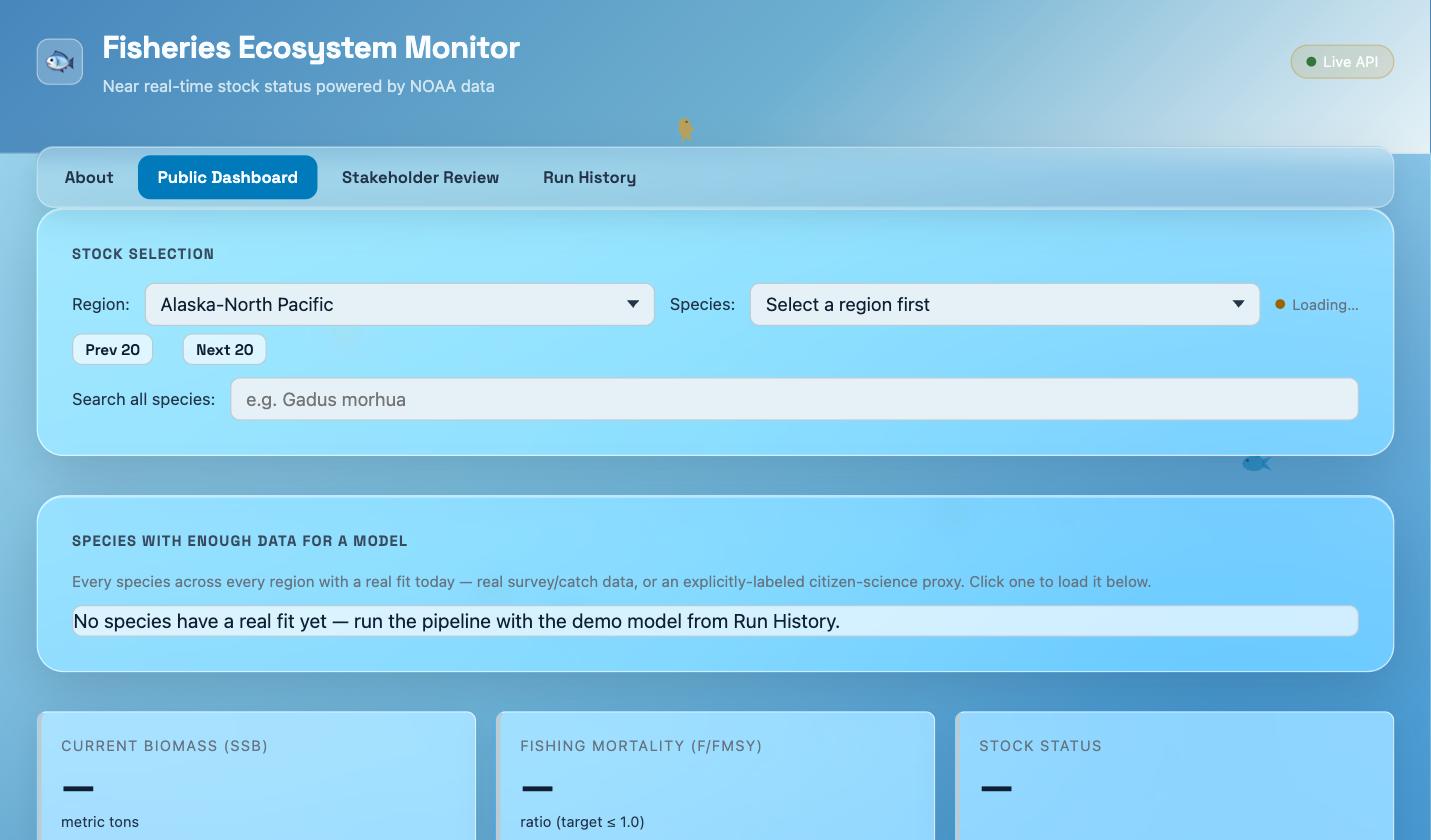
Fisheries Ecosystem Monitor
Platform that automates fisheries stock assessment by harvesting species records, survey data, and catch reports from NOAA and public databases, assembling them into a shared framework, running simplified models (FIMS, WHAM, Demo), and publishing results with quantified uncertainty. Three dashboards serve three audiences: public fish-status browser with biomass and fishing-mortality trends, stakeholder quality-check for citizen reports, and reproducible run history with diffs between pipeline runs.
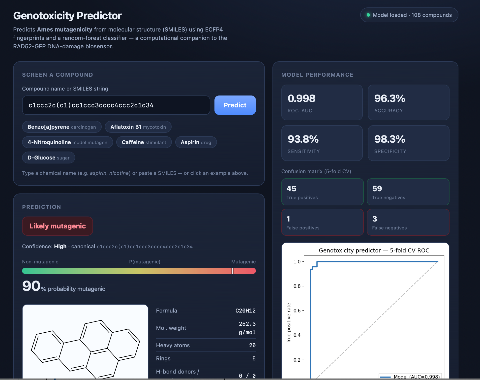
AI Genotoxicity Predictor
A machine-learning companion to the wet-lab RAD52–GFP work that predicts whether a chemical compound is likely to damage DNA, the same genotoxic signal the RAD52–GFP assay is designed to detect in living cells. Enter a compound name or SMILES string and it returns a probability of mutagenicity (Ames), the molecule structure, an applicability-domain check, and the model's cross-validated performance. Under the hood: RDKit ECFP4 fingerprints → a 400-tree random forest, served from a Flask dashboard.
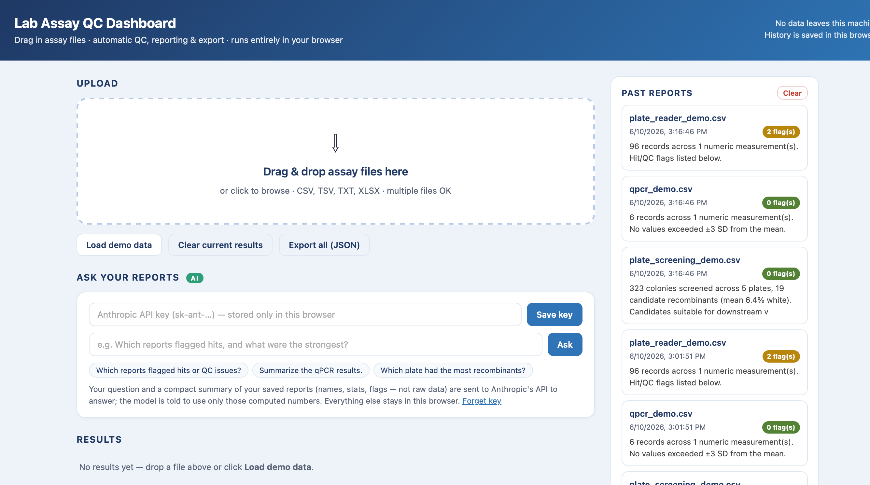
Lab Assay Auto-Report Tool
Drop raw assay files (CSV, TSV, XLSX) into a folder and get a formatted QC report: no spreadsheet wrangling. It auto-detects the data type, from red/white recombinant colony screening to plate-reader RFU and qPCR Cq, and computes totals, per-plate %, means, hit-calls (≥3 SD) and outlier flags. Parsing, statistics and flags are deterministic code: numbers are never invented; an optional grounded Claude step writes the one-line interpretation using only the figures already computed. A watch mode regenerates reports as files land, and an "Ask your reports" box answers natural-language queries. Everything runs locally, with export to HTML, CSV, JSON or PDF.
04. Education & Honors
Ave Maria University
2022 – 2026Coursework: Genetics · Molecular Biology · Microbiology · Botany · Zoology · General & Organic Chemistry · Statistics
Jonathan M. Pawl
Education
Research Experience
- Designed & constructed a RAD52–GFP repair template via Golden Gate Assembly, the donor DNA for a planned yeast (S. cerevisiae) DNA-damage biosensor, relevant to BRCA1/BRCA2-deficient cancers.
- Designed sequence-specific primers; amplified RAD52 & GFP by PCR; verified constructs by gel electrophoresis, plasmid prep & sequence analysis (pGA-red-maxi, pCEC-red).
- Performed DNA extraction, bacterial transformation & red/white colony screening; quantified recombinant clones across replicate platings.
- Once verified, the repair template was intended to be used with a CRISPR-Cas9 plasmid to introduce the GFP tag into RAD52, the next step toward measuring the DNA-damage response by flow cytometry.
- Maintained sterile technique & detailed, reproducible documentation of all protocols, reagents & results.
Projects
- RAD52–GFP Repair Template: donor construct and CRISPR-Cas9 editing strategy for a planned yeast DNA-damage biosensor.
- AI Genotoxicity Predictor: ML tool that predicts whether a compound is genotoxic from its molecular structure, flagging candidates for wet-lab testing.
- Lab Assay Auto-Report Tool: local-first tool that turns raw assay files into formatted QC reports with deterministic stats and a grounded AI summary.
Technical Skills
Honors & Presentations
- St. Albert the Great Biology Research Award (2026)
- Dean's List (2022–2026); academic & athletic scholarships
- Oral Presentation, Florida Academy of Sciences Conference (2026); Poster, AMU Research Symposium (2026)
- NAIA Men's Basketball student-athlete